

Author: Constantine Markopoulos
Captain of the Space Forest Cafe
Mono Club Audio Culture – Constantine Markopoulos
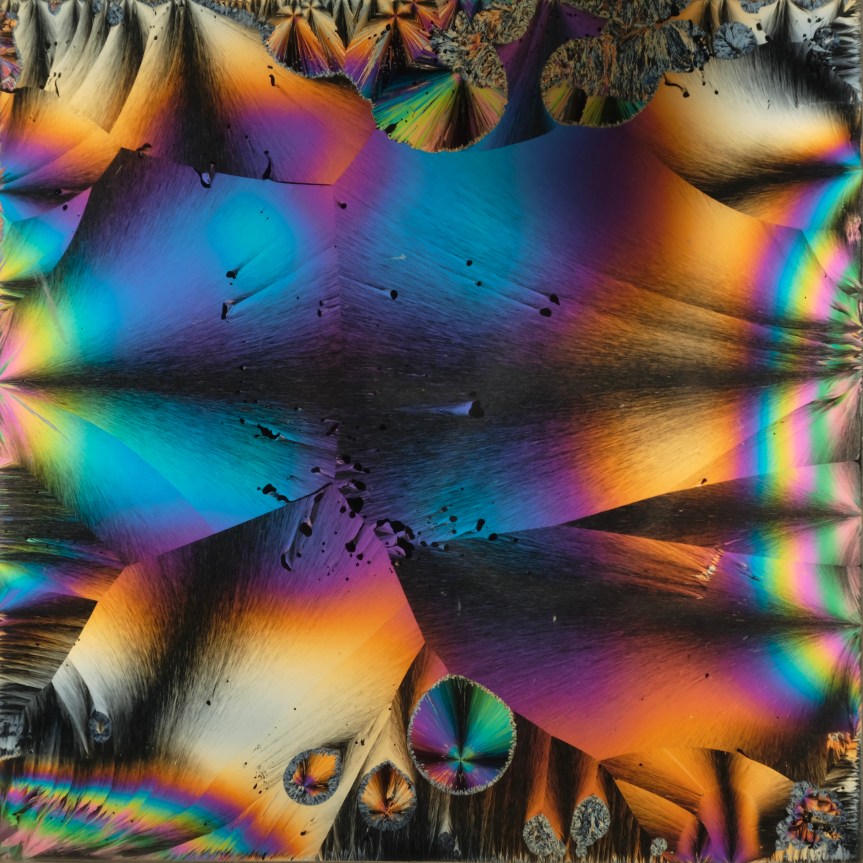
Mono Club Audio Culture is the full spectrum of colors, genres, and textures—an auditory palette that resists the confines of a single lane.
Recorded across multiple continents over a 6 month window, the six tracks each bring a distinct energy, offering a kaleidoscope of tones that capture the essence of a night out, warehouse rave, or desert festival.
The songs blur the lines between electronica, spaced-out electro, acid disco, techno, breakbeat, and house. It’s the kind of music that, when served at the proper moment, can create peaks or moments of introspection on the dancefloor.
From the first beat to the last echo, Mono Club Audio Culture is anything but homogenous.
Optimizing Mic Performance: Mastering Polar Patterns for Recording
In preparation for a grand piano and cello recording session I decided it was time to invest in a studio quality microphone. My local music shop had a B-stock of the AKG C414 XLII on deep discount and I quickly swapped my hard-earned cash for this utility knife of a mic.
The C414 is a condenser microphone with nine selectable polar patterns, three attenuation levels (-6/-12/-18dB), and three bass cut filters. Options are great… but if you’re like me and a bit of a luddite, you might not know which polar patterns work best for different instruments or environments.
To help make sense of these options and what to expect from each polar pattern, I’ll outline the basics here. Then we can get back to recording, even if it’s not perfect, and justify the results with “nobody will sound like me now!” Rules are meant to be broken…maybe we should learn them first? Let’s dive in.
What is a polar pattern?
A polar pattern, also known as a pickup pattern, describes a mic’s sensitivity to sound from various angles or directions. It outlines how well the mic captures sound waves from different directions.
Omnidirectional

360-Degree Pickup: Captures sound evenly from all directions with equal sensitivity.
No Directional Aiming: Doesn’t need to be pointed in a specific direction but can’t be aimed away from unwanted noise, reducing headroom for feedback.
Natural Sound: Delivers the flattest frequency response and best bass response, providing a natural and balanced sound.
Low Sensitivity to Noise: Least sensitive to wind sounds and handling noise.
Ideal for Studio Use: Perfect for studio recording and capturing acoustic instruments or wide sound sources like choirs and orchestras.
Less Suitable for Live Shows: Not ideal for live performances due to its inability to isolate specific sounds.
Cardioid

Heart-Shaped Pickup Pattern: It captures sound primarily from the front, with reduced sensitivity to the sides and minimal pickup from the rear. This heart-shaped pattern gives it its name
Noise Isolation: Effectively isolates the mic from unwanted room or ambient noise, making it ideal for focusing on a single sound source.
Feedback Resistance: Offers increased resistance to feedback compared to omnidirectional microphones, especially useful in loud live environments.
Proximity Effect: Enhances bass frequencies when the sound source is close, adding warmth to vocals and instruments.
X/Y Stereo Technique: Two cardioid mics positioned at a 90-degree angle create the X/Y stereo technique, which provides dedicated left and right recording for stereo sound.
Moderate Sensitivity to Handling Noise: While it isolates sound well, it is more sensitive to handling noise and wind than omnidirectional mics.
Common Uses: Perfect for vocal recordings, live performances, podcasting, and close-miking instruments like guitars and drums.
Wide Cardioid (Also referred to as Subcardioid)

Broader Pickup Pattern: The wide cardioid has a larger pickup area than a standard cardioid, capturing more sound from the sides while still rejecting sound from the rear.
Balance Between Isolation and Ambience: It offers a balance between the focused directionality of a cardioid and the open, ambient capture of an omnidirectional mic, making it suitable for capturing a more natural sound with some isolation.
Less Proximity Effect: Compared to a standard cardioid, the wide cardioid has a less pronounced proximity effect, resulting in more natural bass response when close to the sound source.
Moderate Feedback Resistance: Provides good feedback resistance, though slightly less than a standard cardioid due to its wider pickup pattern.
Ideal for Acoustic Instruments and Ensembles: Works well for recording acoustic instruments, ensembles, or situations where a bit of room sound is desired along with the direct sound.
Versatile Use: Suitable for both studio and live settings where some ambient sound is beneficial, yet some isolation is still needed.
Hyper Cardioid
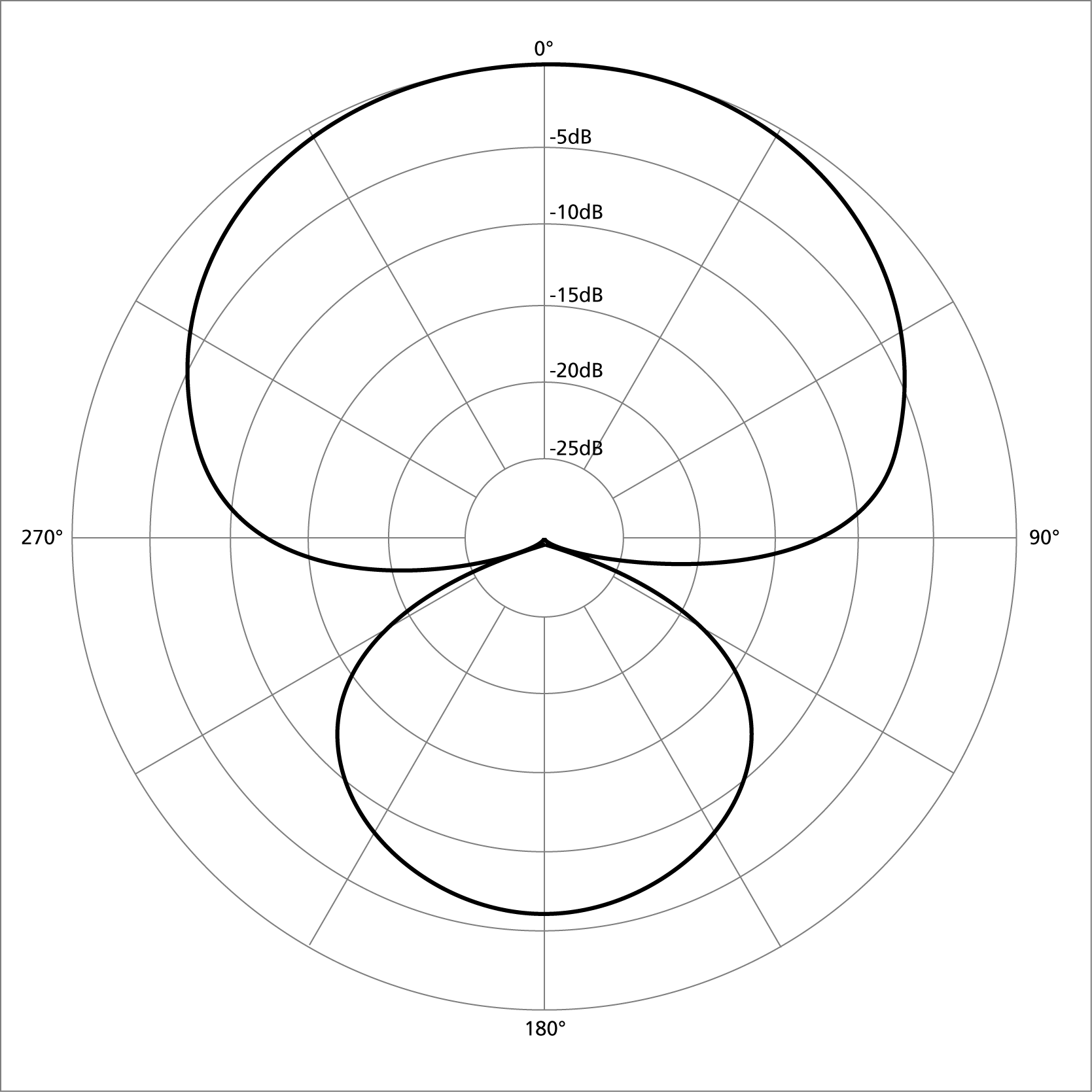
Tighter Pickup Pattern: The hypercardioid has an even more focused pickup pattern than a standard cardioid, capturing sound primarily from the front with a narrow angle of sensitivity.
Greater Isolation: It provides excellent isolation of the desired sound source, making it ideal for environments with a lot of background noise or when you need to focus tightly on a specific sound.
Small Rear Pickup: Unlike the cardioid, the hypercardioid has a small lobe of sensitivity at the rear, meaning it picks up some sound from directly behind the microphone, though much less than from the front.
Stronger Proximity Effect: The hypercardioid exhibits a more pronounced proximity effect, enhancing bass frequencies when the sound source is very close to the mic, which can add depth or warmth to recordings.
High Feedback Resistance: It offers good resistance to feedback, especially from the sides, but is slightly more prone to rear feedback due to the rear lobe.
Ideal for Noisy Environments: It’s well-suited for recording in loud environments, live performances, or when you need to isolate one sound source from others.
Common Uses: Frequently used in situations requiring focused sound capture, such as film, theater, and broadcast, as well as close-miking individual instruments or vocals in a noisy setting.
Figure-eight (bi-directional)
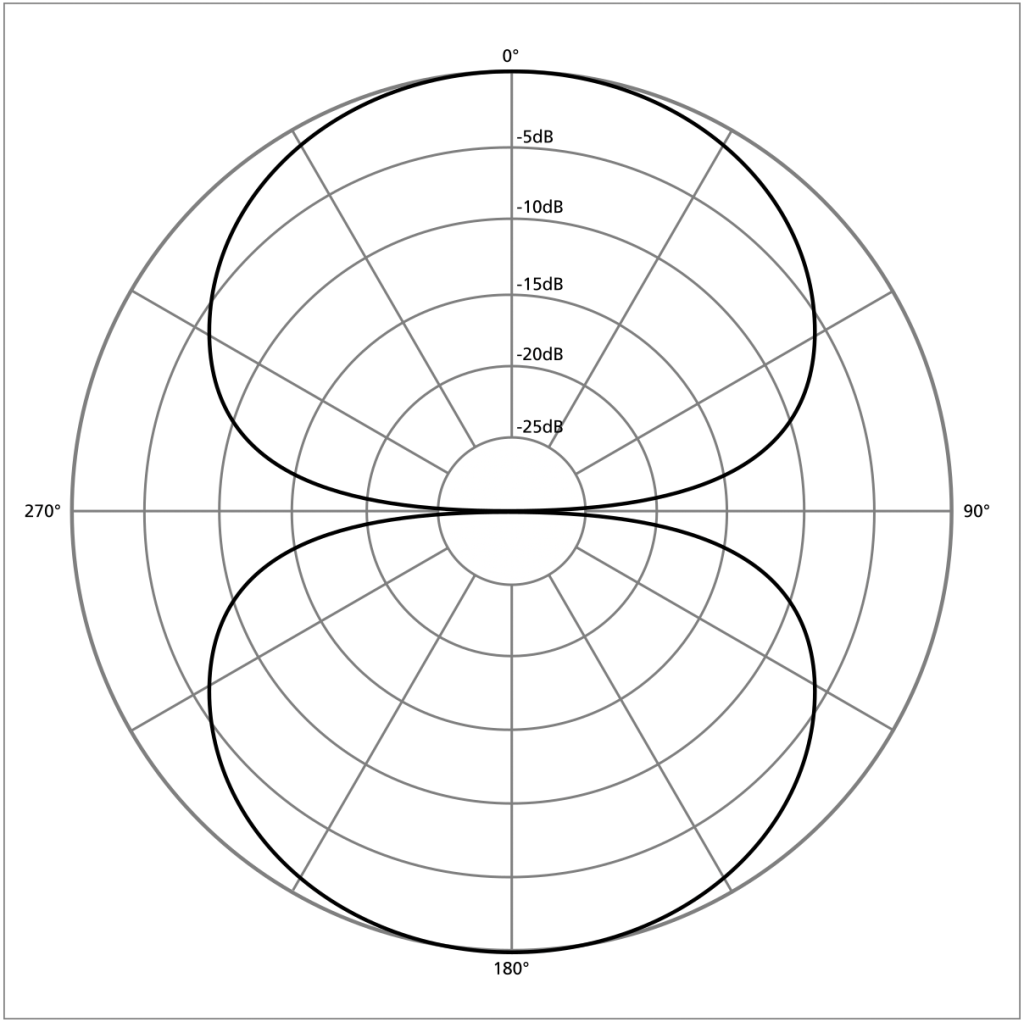
Two-Way Pickup Pattern: The figure-eight pattern captures sound equally from the front and rear while rejecting sound from the sides. This creates a “figure-eight” shape in its sensitivity.
Excellent Side Rejection: It effectively rejects sound coming from the sides, making it ideal for isolating two sound sources positioned in front of and behind the mic.
Strong Proximity Effect: Like hypercardioid mics, the figure-eight pattern exhibits a pronounced proximity effect, which enhances bass frequencies when the sound source is close to the mic.
Ideal for Stereo Recording Techniques: It’s commonly used in stereo recording techniques like Mid-Side (M/S) and Blumlein Pair, allowing for rich stereo imaging and spatial recordings.
Balanced Sound Capture: The figure-eight mic captures a balanced sound from two opposite directions, making it suitable for interviews, duets, or any setup where you want to record two sound sources simultaneously.
Versatile in Studio Settings: It is particularly useful in studio environments where precise control over sound isolation and stereo imaging is important.
Sensitivity to Environment: While effective for specific recording scenarios, it can also pick up unwanted reflections or noise from behind the mic, so careful placement is crucial.
Conclusion
Do something completely unorthodox and get a mic technique named after you. Happy recording!
Piano Diary – Henning Schmiedt

Pair this album with your next Sunday morning coffee…immerse yourself even deeper by picking up a paintbrush or pen. Let the melodies guide your creativity as the day unfolds…
Born from the artist’s daily piano sessions during covid isolation, these compositions evoke memories of a time marked by uncertainty, yet filled with an enduring sense of hope and connection.
Henning has masterfully captured these beautiful, fleeting moments in time with this work.
Memory Collage – Constantine Markopoulos

Is the sense of wonder a universal experience when we gaze up at the heavens on a clear night? Millennia-old light reaches our eyes, born when distant ancestors walked this earth.
I believe that all who acknowledge our place in the cosmos share a dream of galactic exploration. Some find solace and establish order by anchoring themselves in a localized reality, while others weave stories and origin myths, seeking to explain and transcend the mysteries that await above.
For a close-knit collective of friends, choosing to convene beneath cosmic conditions in remote places of ritual across the globe, the journey to the celestial realm is paved with sound.
“Memory Collage” serves as your sonic launchpad to infinite other worlds.
These are the conversations overheard among travelers at the Space Forest Cafe.
Get on the email list for all official release information. The transmission goes global April 8th, 2024.
 Space Forest Cafe