100 Albums, 100 Days

At the turn of the new year, in my tiny Tokyo apartment in Sangenjaya, I made a decision: I wouldn’t focus so much on creation, but rather on inspiration.

The idea came from something an artist I respect said in an interview. It was something like, “If I listen to an album a day, it’s a good day.” That stuck with me. 

So I set a resolution: carve out time each day for one focused, distraction-free listening session with a new album. A simple and enjoyable goal, right? Just forty-five minutes to an hour of daily music appreciation.

Of course, I had selfish motives. Like most of us, I wanted to soak in as much creative source material as possible, hoping it would spark ideas or direction for future music projects.

The first few months were easy breezy. New tunes daily. How exciting.
But it didn’t take long before it got harder to find music I hadn’t already heard, especially without giving in to the algorithmic overlords. So I started asking friends to share their favorites and dug deeper into the corners of the musical universe.

Long story short: I broke the resolution.
Not as fast as your typical January gym-goer (the ones who disappear by February 1st), but after about five months. I was listening daily…on walks, park benches, in living rooms, on airplanes, yoga mats, across multiple countries and continents. You name it.

At some point, I started to feel a little overwhelmed by the sheer number of directions I could take my own music. I was deep into finishing my latest original album Mori, and listening to something new every day across countless genres and moods started making me second guess my own choices. Still, whatever combination of ideas did seep in, I’m thankful for. I’m proud of how Mori turned out.

But this post isn’t about my music. It’s about the artists who inspired me.

So here it is: a reflection on the music that moved me. Tracks that hit hard in DJ sets, lifted my mood, soothed my spirit, or stayed with me as full length journeys worth revisiting.

Below is a list of featured albums and standout tracks, a stream of sonic memories and creative sparks from those listening sessions, followed by the rest of the 100+ albums I explored in the first half of the year, in no particular order.

Hope you find something new here and it encourages you to dig deeper into the collective consciousness of music!

Featured Albums & Tracks

A curated selection from my listening experiment. Specific tracks and records that left a lasting impression, each tied to a moment, a mood, or a memory.


The Summer Portraits – Ludovico Einaudi
Track: “Pathos”
A soundtrack to your life. Hopeful and optimistic.


Fragmente – Felix Rösch
Track: “Residuum”
Songs to cry to. A haunting, cinematic piece that lingers in the air.


Out of the Pathetic Age – DJ Shadow
Track: “Rocket Fuel”
Blow out the speakers. Dust off your sneakers.


Somersault – Chicane
Track: “Always”
Classic dancefloor euphoria. Capital E energy.


Reclamando Nuestro Espacio – Adolescent’s Orquestra
Track: “Anhelo”
Good vibes in four minutes. Tropical, jazzy, soulful.


Harmônicos – Fabiano do Nascimento
Track: “Chuva”
Instrumental virtuosity. Brazilian guitar meditation.


Chant Music For Paradise
Track: “Libera Me”
Healing and heavenly. Gregorian ambient peace.


This Is It – Celeda
Track: “Be Yourself and No One Else”
This is our house. Let’s dance.


Labcabincalifornia – The Pharcyde
Track: “Runnin’”
A portal to another world. Timeless hip-hop soul.


Buena Vista Social Club
Track: “Chan Chan”
The sound of Cuba. Romance, nostalgia, rhythm.


By the Deep Sea – Federico Albanese
Track: “Boardwalk”
A soundtrack to uncertainty. Dreamlike and distant.


Próxima Estación: Esperanza – Manu Chao
Track: “Me Gustas Tú”
Depression antidote. Feel good anthem.


Lazarus – Bonobo (Adult Swim Soundtrack)
Track: “Rings”
Lost in reverie. Dreaming of Japan.


Knock Knock – DJ Koze
Track: “Pick Up”
Classic house meets disco. Instant uplift.


Under Tangled Silence
Track: “Reprise”
Electronic futurism meets classical. Chaotic yet minimal. One of One.


Never Enough – Turnstile
Track: “DULL”
Angsty teenage feels. Not a phase.


Red Morning – DJ Sodeyama, The People in Fog
Track: “Red Morning”
Peaking on the dance-floor at dawn.


Mexican Alps – Niklas Paschburg
Track: “Moos”
Soundtrack to life. Emotional and reflective.


76:14 – Global Communication
Track:“9:39”
Spaced out ambient bliss. What is the meaning of life?


Remaining albums:

Perceive Its Beauty. Acknowledge Its Grace – Shabaka

Hi Note – Gerargo

Symbol – Susumu Tokota

Underbelly – Kiltro

Sings for Two in Love – Nat King Cole

Break First – Boztown

Good Evening Black Buddha

Silfra – Hilary Hahn

Imagine This Is a High Dimensional Space of All Possibilities – James Holden

Ketteiban!! – Isao Saito

Spirit Walking – Jordan Ireland

Psycho Tropical Berlin

Late Night Tales – Nils Frahm

Kid for Today – Boards of Canada

Perom from a Rooftop

Yoshida Brothers (1999–2004)

Dustland – The Gentleman Loses

Ten Days – Fred Again

Lahai – Sampha

Lifeforms – The Future Sound of London

MTV Unplugged in New York – Nirvana

Everybody Loves the Sunshine – Roy Ayers Ubiquity

In Conflict – Owen Pallett

Chameleon Sunday – Arc De Soleil

Carlos Erasmo Versão Som (Bonus)

Where the Streets Lead – Slowly Rolling Camera

Out of the Unknown – ZG

Music of Documentaries – Lawrence Le Doux

You’ve Got It Bad Girl – Quincy Jones

Talking Book – Stevie Wonder

Don Shirley Trio – Don Shirley

It’s Snowing on My Piano – Bugge Wesseltoft

Simple Things – Zero 7

The Colour and the Shape – Foo Fighters

Welcome to Sky Valley – Kyuss

Who’s Next (Deluxe Edition) – The Who

A Long Vacation – Eiichi Ohtaki

De Stijl – The White Stripes

Samurai Champloo Music Record: Impression – Force of Nature

Magic Seeds II – Leifur James

Songs for the Deaf – Queens of the Stone Age

The Balaclava Diaries – Heron Flow

Stand! – Sly and the Family Stone

DJ-Kicks: The Exclusives – Various Artists

Playgroup – Playgroup

Yuming Brand – Yumi Arai

Utility – Barker

Obscurity Continuum – Fat Jon

Mahal – Glass Beams

The Los Angeles League of Musicians

Stories from Far Away on Piano – James Heather

Ritual: Nothing Is Lost – Jon Hopkins

Nothing – Darkside

The Mountain Will Fall – DJ Shadow

On Being – Max Cooper

The Fat of the Land – The Prodigy

Temple Road (Extended) – Naâman

Scenery – Ryo Fukui

Gravity – Joona Toivanen Trio

Tribal Organic: Deep Dive into European Percussions (’79–’90)

Signals at Both Ears – Gonubie

WE – Laura Masotto

Louie – Kenny Beats

Lucid Dreams – Chihei Hatakeyama

Omura / Fracture – Sam Binga

Almoraima – Paco de Lucía

La Leyenda del Tiempo – Camarón de la Isla

De Aki a Ketama – Ketama

Sunshine – Hector Plimmer

Sincere (Deluxe) – MJ Cole

The Spirit of Things (Rework) – Laura Masotto

Out of the Dust – Hior Chronik

Suite No. 6 – Candy Chic

In a Landscape – Max Richter

Engravings – Forest Swords

Slow Eastbound Train – Daniel Herskedal

Tree – John Metcalfe

Fin – John Talabot

Hissing Fauna, Are You the Destroyer? – Of Montreal

Searching – Tristan de Liège

Fractals – Various Artists

Entropy – Asta Hiroki

Blackbirds and the Sun of October – Federico Albanese

Donau – Florian Christl

F♯ A♯ ∞ – Godspeed You! Black Emperor

Cendre – Fennesz & Ryuichi Sakamoto

Windswept Adan – Ichiko Aoba

Angel in Disguise – Leifur James

Music Can Hear Us – DJ Koze

Lazarus Adult Swim Soundtrack (Floating Points)

Stochastic Drift – Barker

Unidad de Desplazamiento – Los Planetas

Phantom Brickworks LPII – Bibio

The Disintegration Loops Remastered – William Basinski

Luxury Problems – Andy Stott

Sound & Color – Alabama Shakes

Malesch – Agitation Free

Isla – Different Populous

Searching for Soul: Soul Funk & Jazz Rarities from Michigan – Various Artists

Piano Day Vol. 1

Piano Day Vol. 2

Piano Day Vol. 3

Piano Day Vol. 4

Think & Change – Various Artists

Friedrich – Stimming

Ruhe – Rubin Henkel

Seelie – CLANN

See You When You Get There – Session Victim

Optimizing Mic Performance: Mastering Polar Patterns for Recording

In preparation for a grand piano and cello recording session I decided it was time to invest in a studio quality microphone. My local music shop had a B-stock of the AKG C414 XLII on deep discount and I quickly swapped my hard-earned cash for this utility knife of a mic.

The C414 is a condenser microphone with nine selectable polar patterns, three attenuation levels (-6/-12/-18dB), and three bass cut filters. Options are great… but if you’re like me and a bit of a luddite, you might not know which polar patterns work best for different instruments or environments.

To help make sense of these options and what to expect from each polar pattern, I’ll outline the basics here. Then we can get back to recording, even if it’s not perfect, and justify the results with “nobody will sound like me now!” Rules are meant to be broken…maybe we should learn them first? Let’s dive in.

What is a polar pattern?

A polar pattern, also known as a pickup pattern, describes a mic’s sensitivity to sound from various angles or directions. It outlines how well the mic captures sound waves from different directions.

Omnidirectional

360-Degree Pickup: Captures sound evenly from all directions with equal sensitivity.

No Directional Aiming: Doesn’t need to be pointed in a specific direction but can’t be aimed away from unwanted noise, reducing headroom for feedback.

Natural Sound: Delivers the flattest frequency response and best bass response, providing a natural and balanced sound.

Low Sensitivity to Noise: Least sensitive to wind sounds and handling noise.

Ideal for Studio Use: Perfect for studio recording and capturing acoustic instruments or wide sound sources like choirs and orchestras.

Less Suitable for Live Shows: Not ideal for live performances due to its inability to isolate specific sounds.

Cardioid

Heart-Shaped Pickup Pattern: It captures sound primarily from the front, with reduced sensitivity to the sides and minimal pickup from the rear. This heart-shaped pattern gives it its name

Noise Isolation: Effectively isolates the mic from unwanted room or ambient noise, making it ideal for focusing on a single sound source.

Feedback Resistance: Offers increased resistance to feedback compared to omnidirectional microphones, especially useful in loud live environments.

Proximity Effect: Enhances bass frequencies when the sound source is close, adding warmth to vocals and instruments.

X/Y Stereo Technique: Two cardioid mics positioned at a 90-degree angle create the X/Y stereo technique, which provides dedicated left and right recording for stereo sound.

Moderate Sensitivity to Handling Noise: While it isolates sound well, it is more sensitive to handling noise and wind than omnidirectional mics.

Common Uses: Perfect for vocal recordings, live performances, podcasting, and close-miking instruments like guitars and drums.

Wide Cardioid (Also referred to as Subcardioid)

Broader Pickup Pattern: The wide cardioid has a larger pickup area than a standard cardioid, capturing more sound from the sides while still rejecting sound from the rear.

Balance Between Isolation and Ambience: It offers a balance between the focused directionality of a cardioid and the open, ambient capture of an omnidirectional mic, making it suitable for capturing a more natural sound with some isolation.

Less Proximity Effect: Compared to a standard cardioid, the wide cardioid has a less pronounced proximity effect, resulting in more natural bass response when close to the sound source.

Moderate Feedback Resistance: Provides good feedback resistance, though slightly less than a standard cardioid due to its wider pickup pattern.

Ideal for Acoustic Instruments and Ensembles: Works well for recording acoustic instruments, ensembles, or situations where a bit of room sound is desired along with the direct sound.

Versatile Use: Suitable for both studio and live settings where some ambient sound is beneficial, yet some isolation is still needed.

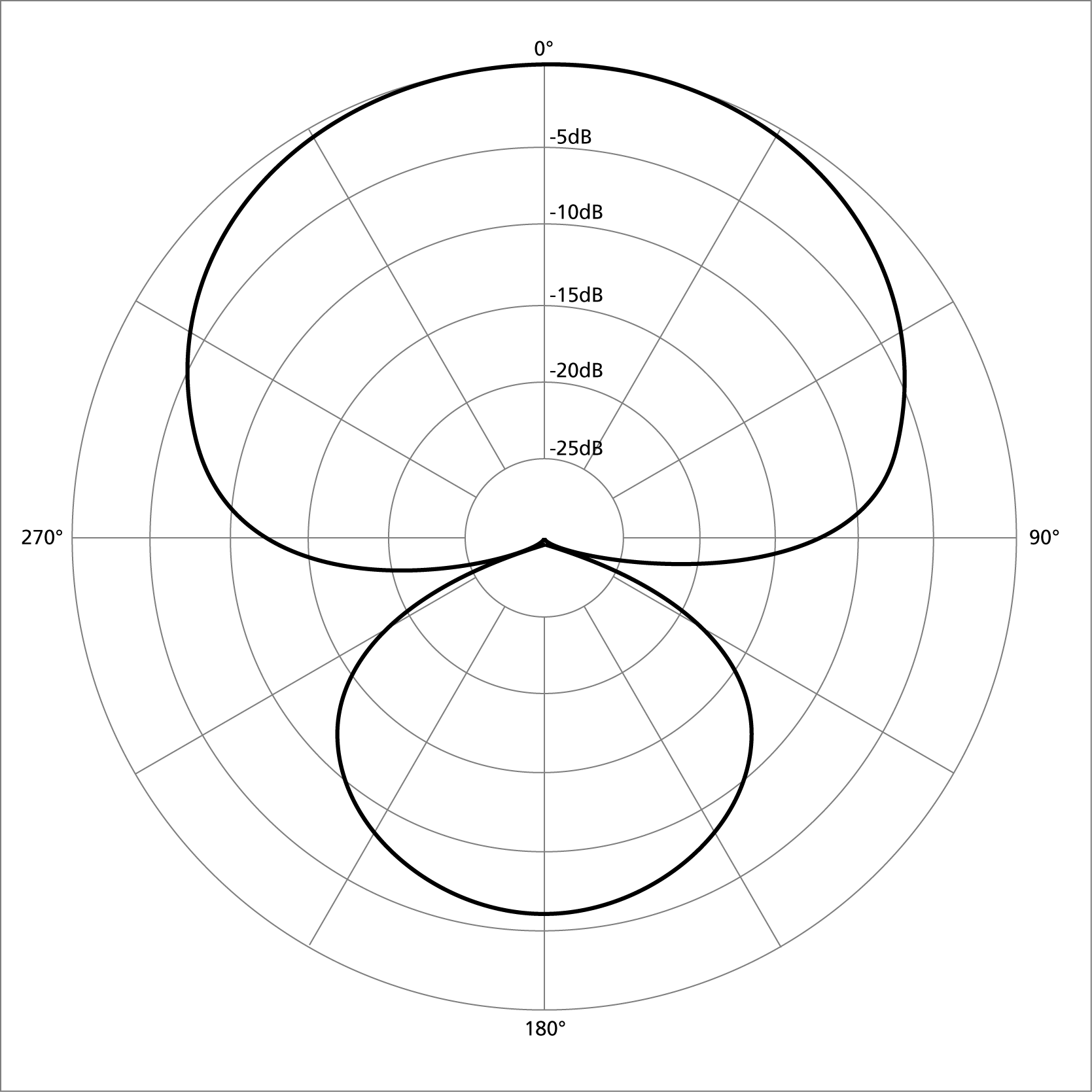
Hyper Cardioid

Tighter Pickup Pattern: The hypercardioid has an even more focused pickup pattern than a standard cardioid, capturing sound primarily from the front with a narrow angle of sensitivity.

Greater Isolation: It provides excellent isolation of the desired sound source, making it ideal for environments with a lot of background noise or when you need to focus tightly on a specific sound.

Small Rear Pickup: Unlike the cardioid, the hypercardioid has a small lobe of sensitivity at the rear, meaning it picks up some sound from directly behind the microphone, though much less than from the front.

Stronger Proximity Effect: The hypercardioid exhibits a more pronounced proximity effect, enhancing bass frequencies when the sound source is very close to the mic, which can add depth or warmth to recordings.

High Feedback Resistance: It offers good resistance to feedback, especially from the sides, but is slightly more prone to rear feedback due to the rear lobe.

Ideal for Noisy Environments: It’s well-suited for recording in loud environments, live performances, or when you need to isolate one sound source from others.

Common Uses: Frequently used in situations requiring focused sound capture, such as film, theater, and broadcast, as well as close-miking individual instruments or vocals in a noisy setting.

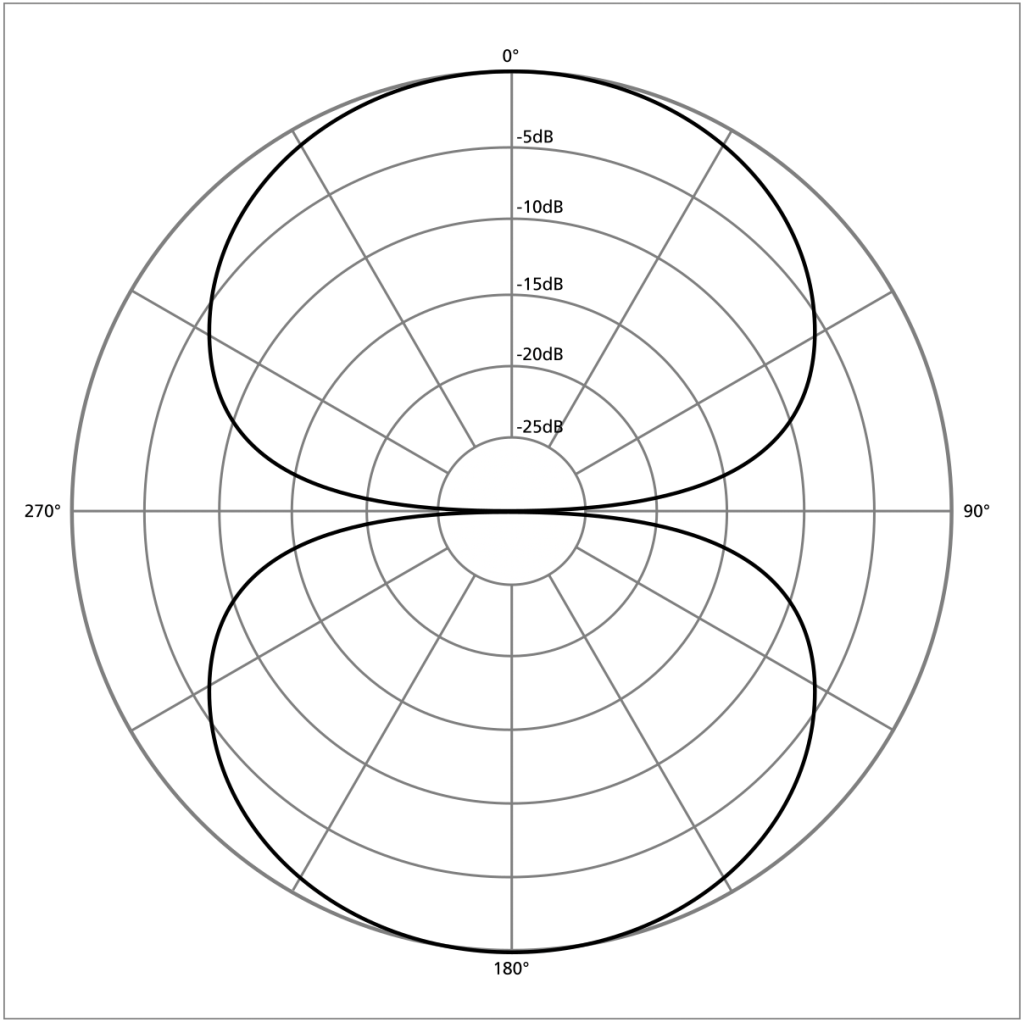
Figure-eight (bi-directional)

Two-Way Pickup Pattern: The figure-eight pattern captures sound equally from the front and rear while rejecting sound from the sides. This creates a “figure-eight” shape in its sensitivity.

Excellent Side Rejection: It effectively rejects sound coming from the sides, making it ideal for isolating two sound sources positioned in front of and behind the mic.

Strong Proximity Effect: Like hypercardioid mics, the figure-eight pattern exhibits a pronounced proximity effect, which enhances bass frequencies when the sound source is close to the mic.

Ideal for Stereo Recording Techniques: It’s commonly used in stereo recording techniques like Mid-Side (M/S) and Blumlein Pair, allowing for rich stereo imaging and spatial recordings.

Balanced Sound Capture: The figure-eight mic captures a balanced sound from two opposite directions, making it suitable for interviews, duets, or any setup where you want to record two sound sources simultaneously.

Versatile in Studio Settings: It is particularly useful in studio environments where precise control over sound isolation and stereo imaging is important.

Sensitivity to Environment: While effective for specific recording scenarios, it can also pick up unwanted reflections or noise from behind the mic, so careful placement is crucial.

Conclusion

Do something completely unorthodox and get a mic technique named after you. Happy recording!

The Creative War of Acting and Being an Artist

I highly recommend two books on boosting creativity and productivity that have had a significant impact on me through multiple readings.

The first one is “The War of Art” by Steven Pressfield, and the second, a more recent publication, is “The Creative Act: A Way of Being” by Rick Rubin. Both books motivate you to either kickstart or complete any projects you may have left unfinished.

If you’re not a fan of self-improvement literature or reading in general, you might find this podcast featuring both authors to be a flavorful introduction to the ideas presented in their respective books.

The war and way continues…

Production Podcast – “Hanging Out With Audiophiles”

Apple’s algorithm recommended this pod to me and I will double down on my AI overlord’s suggestion with my personal stamp of approval (not that my opinion is worth anything) for anyone interested in modern music production.

I have already absorbed three interviews with some heavy hitters in the electronic space who I am genuine fans of.

HOWA’s host Jamie Lidell is unique and personable. He provides actionable studio tips before diving into the guest interview where he covers the creative process, gear, mixing, and personal stories to inspire your own practice.

Take a look at the episode archives and find a name you recognize or roll the dice and go somewhere new to see what you can learn!